Every time the topic of AI in music comes up, the conversation goes to the same place: is AI going to replace musicians?
I think that's the wrong question. Or at least, it's not the one that keeps me up at night.
The underlying fear isn't that a machine composes. Machines have been taking part in how we make music for decades —the sequencer, the sampler, autotune, the quantizer. The real fear is more specific and more uncomfortable: that AI takes part in your work and afterwards it's not clear what you put in and what it put in. That the credit gets blurred. That one day your work is worth less because no one can prove it was yours.
That problem is legitimate. And it isn't solved with good intentions or pretty manifestos. It's solved with infrastructure.
The problem isn't AI. It's opacity.
Think about how most generative AI music tools work today. You ask for something, it hands you a result, and in between there's a black box. You don't know how much of what came out is yours. There's no record of how much you contributed to the decision and how much the model resolved on its own.
That opacity is the real problem. Because when there's no record, two things happen, and both are bad:
The first is that the honest artist is left in a fragile position. If tomorrow someone questions the authorship of your track, you have nothing to respond with. "Trust me" is not a legal or commercial argument.
The second is that the dishonest artist can pass off as their own something that was almost entirely generated. And that, in the long run, contaminates the trust of the whole industry. When platforms can't tell the difference, they end up punishing everyone: they take down tracks, freeze accounts, suspect by default.
Opacity protects no one. It only suits whoever wants to hide something.
My thesis: the record changes everything
I come from software. And in software we solved a very similar problem years ago.
When many people work on the same codebase, we don't say "let's trust that everyone remembers what they did". We have a system —version control— that records every change: who made it, when, and what exactly they touched. It's not bureaucracy. It's what makes it possible for many people to collaborate without fighting over credit and without stepping on each other's work.
Music with AI needs its own version of that.
When a tool takes part in making music, there has to be a record of how much it put in and how much you put in. Not out of distrust. For clarity.
If every AI-assisted decision is recorded —what the model proposed, what you accepted, what you modified, what you rejected— then authorship stops being a matter of faith. It becomes a verifiable fact. And a verifiable fact protects you: before a platform, before a label, before a collaborator, before the future.
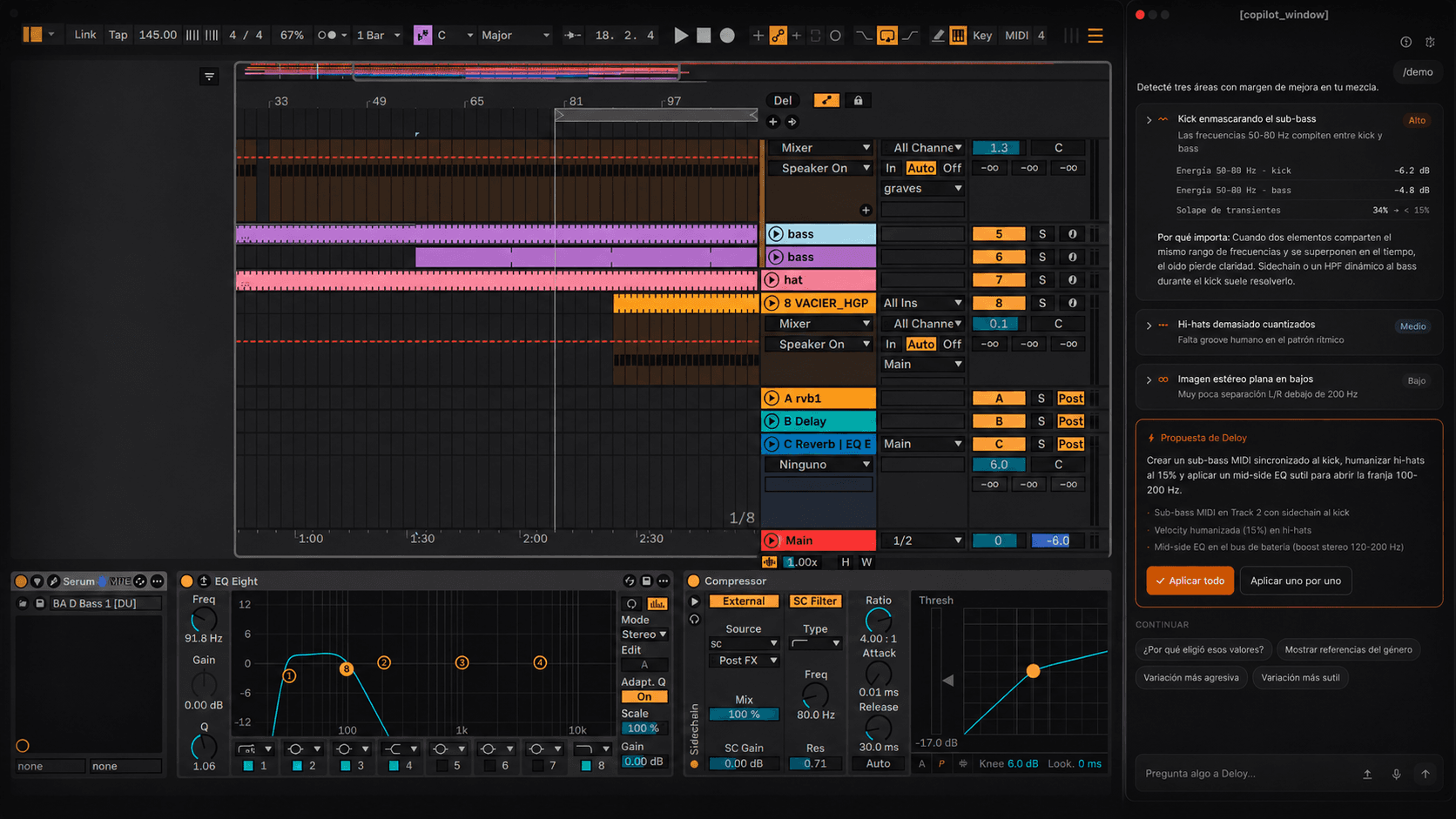
That's what I'm building with Deloy. Not an AI that replaces you, but an AI that leaves a record. Every track that goes through Deloy can carry a certificate of its own history: how much was human, how much was assistance, signed in a way that can't be forged. We call it Deloy DNA.
Why this is a responsibility, not a feature
I work every day at the most cutting edge of technology. And from there I see something fairly clearly: the foundations of how the music industry is going to use AI are being laid now. In these years. By the tools that get built today and the decisions they make.
If those foundations are laid badly —opaque, deceptive, designed to hide rather than show— we'll drag that problem along for decades. And the ones who'll pay the cost are the artists, who are precisely the ones this technology should serve.
That's why I don't see the authorship record as just another feature on a list. I see it as a responsibility. I honestly believe AI in music has to be built in the most legitimate, transparent and artist-respecting way possible. Not because it sounds good to say it, but because it's the only way this ends well for everyone.
AI is going to be in music. That's no longer up for debate. What we can decide is how.
What I'm not saying
I'm not saying all AI music has to sound a particular way, nor that there's a "correct" way to create. Everyone uses the tools how they want.
Nor am I saying AI should be limited. On the contrary: the more powerful the assistance, the better, as long as the human keeps the final word and as long as it's clear who did what.
The only thing I'm defending is this: that the producer remains the author, and that this is demonstrable. That you can use all the power of AI without having to give up what's yours, or end up in a fragile position for having done so.
That's the line. Everything I build is organized around it.
Where this is heading
I think in a few years a track's authorship certificate will be as normal as an ISRC is today. You won't publish anything without it. Platforms will ask for it, labels will demand it, and artists will want it because it protects them.
When that day comes, I'd like us to remember it as the moment the industry decided to do things right. Not hide AI, nor ban it, but integrate it honestly.
That's the foundation I want to help lay. And it is, at heart, the reason Deloy exists.
— Cristian